




Water Crimes and International Law: The Need for Accountability
https://doi.org/10.71609/iheid-ax5j-2193The need for accountability for violations of international law during armed conflicts is increasingly growing. The current conflicts in Ukraine, Gaza or Sudan vividly illustrate the extent of non-compliance with international humanitarian law, together with other bodies of law such as international human rights law and international environmental law, as endorsed in the Geneva List of Principles on the Protection on Water Infrastructure. Both deliberate attacks on water systems and the deprivation of civilian access to water supplies, as well as incidental damage to the infrastructure, are emerging as deeply worrying trends in contemporary armed conflicts. During armed conflicts, water crimes are unfortunately common. For instance, the targeting of industrial facilities often involves pollution of surface and groundwater resources. Crimes against water often take the form of intentional damage to water installations. For example, Iraq has suffered from systematic and extensive sabotage and looting by ISIS. ISIS seized control of critical dams in order to exert hegemony over downstream cities and rural areas by either cutting off water supplies or releasing a flood wave to submerge government-controlled areas.
International humanitarian law is clear that starvation is prohibited during international and non-international armed conflicts. This prohibition includes a ban on attacking, destroying, removing or rendering useless objects indispensable to the survival of the civilian population such as drinking water installations and supplies as well as irrigation works. International humanitarian law further underscores that if civilian population lacks basic supplies, impartial humanitarian relief actions shall be undertaken. The rules governing the conduct of hostilities also prohibit deliberate, indiscriminate, and disproportionate attacks against civilian objects.
The Statute of the International Criminal Court (ICC) is also clear in affirming that intentionally using starvation of civilians as a method of warfare by depriving them of objects indispensable to their survival, including wilfully impeding relief supplies, is a war crime in international armed conflicts. Besides, it criminalises intentionally directing attacks against civilian objects and launching clearly excessive disproportionate attacks, including those that would cause widespread, long-term and severe damage to the natural environment (at least in international armed conflicts).
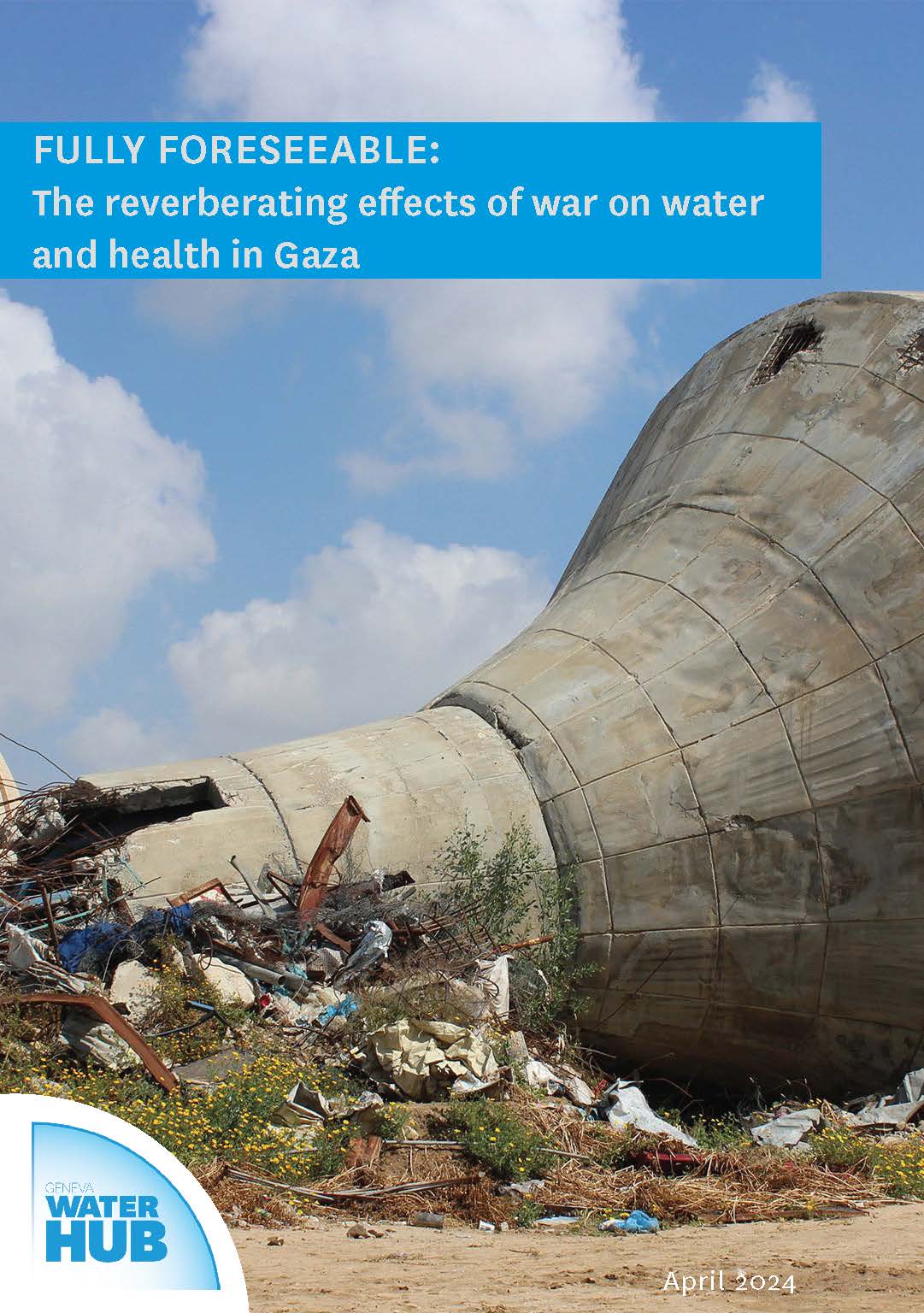
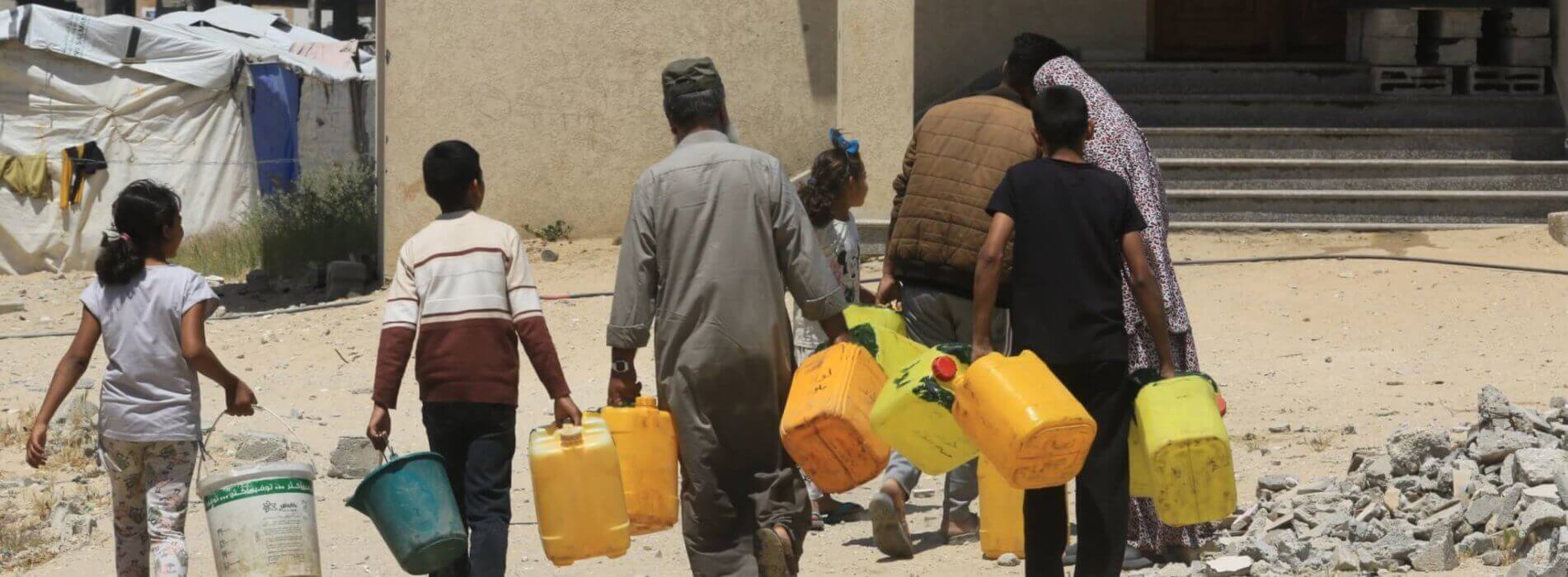
Deprivation of fresh water may constitute a crime against humanity. Depriving people of water implies the commission of inhumane acts, which is part of the definition of a crime against humanity. The commission of inhumane acts involves those responsible for the acts intentionally causing great suffering and injury to the physical or mental health of people. Crimes against humanity can take place in both armed conflicts and peacetime. A report of the Geneva Water Hub has underlined the multiple and far-reaching consequences of the deprivation of clean water on public health. The increase of waterborne diseases, including cholera, in conflict settings is a common trend. In the conflict in Gaza, poor hygiene conditions in overcrowded shelters create fertile ground for rapid disease transmission. United Nations experts have denounced the use of “thirst as a weapon” in Gaza and noted the repeated targeting of water facilities, wells, pipelines, desalinisation units and sewage systems. Such acts may provide evidence for arguing for the existence of war crimes, crimes against humanity and even genocide. Moreover, the International Court of Justice (ICJ) has already noted in its Order of March 2024 that Palestinians in Gaza are no longer facing only a risk of famine, “but that famine is setting in”. Interestingly, the ICJ discusses together starvation and dehydration of Palestinians in Gaza as possible grounds for the violation of the Convention on the Prevention and Punishment of the Crime of Genocide. In parallel, at the ICC — although the warrants of arrest for Israeli Prime Minister Benjamin Netanyahu and his former Defence Minister Yoav Gallant are classified as confidential to safeguard the conduct of the investigations — the Pre-Trial Chamber has indicated that there are reasonable grounds to believe that both individuals have intentionally and knowingly deprived the civilian population in Gaza of objects indispensable to their survival, including water.
Although international humanitarian law and international criminal law protect access to fresh water for the population and although intentional deprivation of water may constitute a war crime, a crime against humanity or an element of the crime of genocide, the weaponisation of water is still a neglected topic of international law, especially in the case law of international jurisdictions.Intentional deprivation of water may constitute a war crime, a crime against humanity or an element of the crime of genocide. There have been, however, some exceptions in the past. For example, in a case related to the conflict throughout the Darfur region, brought before the ICC, the Office of the Prosecutor reported in 2008 that “[m]ilitia/Janjaweed and the Armed Forces repeatedly destroyed, polluted or poisoned … wells so as to deprive the villagers of water needed for survival. In a number of cases, water installations were bombed”. Reversing a previous conclusion, the 2010 second Decision on the Prosecution’s Application for a Warrant of Arrest against Omar al-Bashir finds that there are reasonable grounds to believe that the elements of genocide are fulfilled. This conclusion also relies on the acts of contamination of water which, according to the Pre-Trial Chamber, “were committed in the furtherance of a genocidal policy” and on the fact that deprivation of water inflicts inhumane conditions of life to the civilians calculated to bring the destruction of an ethnic group.
Water crimes are closely connected to environmental crimes. In international law, there is a debate on the emergence of ecocide as a new international crime, to be included in the Rome Statute alongside genocide, war crimes, crimes against humanity and the crime of aggression. In 2019, Vanuatu raised the issue of the need to criminalise ecocide under the Rome Statute to the Assembly of the States Parties of the ICC. Discussion on water crimes is, however, still rare. The ICC Prosecutor’s Draft Policy on Environmental Crimes under the Rome Statute (2024) links severe harm to water systems with the Court’s four core crimes, advancing the recognition of water-related offenses under international law.
Based on previous research, I propose two main types of water crimes: 1) crimes that affect the quantity or the quality of freshwater resources and the ecosystems dependent on these resources; and 2) crimes that affect water installations, works and facilities. Such crimes can take place both in armed conflicts and peacetime.
I argue that a possible avenue to make water crimes more visible is the development of an analytical framework focused on their normative content. This framework relies on green criminology. Since the 1970s, this branch of criminology addresses the linkages between environmental harm and criminal law and can provide a theoretical basis for the analysis of water crimes. Moreover, this framework can take advantage of social and ecological justice theories to support the need to develop scientific knowledge on water crimes. The goal of such an analytical framework will be to ensure accountability in cases of criminal offences as well as adequate forms of repression such as civil and penal sanctions.
The aim of increasing the analysis of the normative content of water crimes is to enhance accountability in cases of violation of international law norms. The definition of water crimes contributes to the protection of fundamental human rights, such as the human right to safe drinking water. The study of water crimes should also include the development of an inventory to monitor how States respond to them. Monitoring and accountability can be facilitated by global, regional and bilateral agreements on transboundary water resources. For instance, the Annex on Environmental Protection to the Water Charter of the Niger Basin includes aspects related to criminal law stating that the authors of bushfires and their accomplices shall be liable to civil and criminal penalties. An example of an international treaty with a specific focus on the protection of the environment through criminal law is the 1998 Council of Europe Convention on the Protection of the Environment through Criminal Law (updated in 2025). This instrument includes specific water crimes (Art. 24) and reflects the provisions of the new EU Environmental Crime Directive (2024).
The increasing use of water as a method or means of warfare — and thus its weaponisation — requires scholars to adopt multidisciplinary approaches to the analysis of harm to water supplies and the deprivation of a fundamental human right. At a time when rivers are acquiring legal personhood, using the lens of criminal law to study the response of States to violations of domestic or international laws can support the accountability of those responsible for such violations. This is especially important given the fact that water is not only a vital resource but a fundamental human right of individuals and communities.
Electronic reference
Tignino, Mara. “Water Crimes and International Law: The Need for Accountability.” Global Challenges, no. 18, December 2025. URL: https://globalchallenges.ch/issue/18/water-crimes-and-international-law-the-need-for-accountability. DOI: https://doi.org/10.71609/iheid-ax5j-2193.Dossier produced by the Geneva Graduate Institute’s Research Office.
BOX 1 | Definition of the Concept of Genocide
The concept of genocide was defined legally for the first time in the Convention on the Prevention and Punishment of the Crime of Genocide, adopted by the United Nations General Assembly on 9 December 1948. According to Article II of this Convention, genocide means
“any of the following acts committed with intent to destroy, in whole or in part, a national, ethnic, racial or religious group, as such:
a) Killing members of the group;
b) Causing serious bodily or mental harm to members of the group;
c) Deliberately inflicting on the group conditions of life calculated to bring about its physical destruction in whole or in part;
d) Imposing measures intended to prevent births within the group;
e) Forcibly transferring children of the group to another group.
To be noted: “Measures intended to prevent births’”, such as forced sterilisation, can therefore be legally considered an act constituting genocide — provided that the deliberate intention to destroy a targeted group can be proven. It is this dimension of genocidal intent that makes it difficult to legally recognise forced sterilisation as genocide, even if it technically meets the criteria defined by the Convention (Case Matrix Network)
Source: United Nations, Convention on the Prevention and Punishment of the Crime of Genocide.
GRAND ENTRETIEN | Genocide, with Paola Gaeta
Research Office, Geneva Graduate Institute
PODCAST | Past, Present and Future of Genocide. Annyssa Bellal
Research Office, Geneva Graduate Institute
PODCAST | Logiques néocoloniales, responsabilité française et génocide rwandais. J.-F. Bayart
Research Office, Geneva Graduate Institute
PODCAST | Israel’s Weaponisation of Water in Gaza
BOX 2 | Genocides: UN Recognition and Historical Consensus
- The Holocaust (Shoah) (1941–1945), recognised via UN General Assembly Resolution 96 (I) in 1946, which led to the 1948 Genocide Convention
- Genocide against the Tutsi (Rwanda, 1994), recognised by UN Security Council Resolutions 955 and 978 (1994); International Criminal Tribunal for Rwanda (ICTR) established
- Srebrenica Genocide (Bosnia, 1995), recognised by the International Criminal Tribunal for the former Yugoslavia (ICTY) and the International Court of Justice (2007 ruling)
- Herero and Nama Genocide (German Southwest Africa, 1904–1908), recognised by Germany (2021)
- Assyrian and Pontic Greek Genocides (1914–1923), recognised by some national parliaments
- Armenian Genocide (1915–1917), recognised by many national parliaments (France, Germany, Canada, etc.)
- Holodomor (Ukraine famine) (1932–1933), recognised by Ukraine and several other countries
- Cambodian Genocide (1975–1979), recognised by the Extraordinary Chambers in the Courts of Cambodia (ECCC)
- Anfal Campaign against Kurds (Iraq, 1988), recognised by several national courts
- Darfur Genocide (Sudan, 2003–present), prosecuted by the International Criminal Court; UN uses “crimes against humanity”
- Destruction of Indigenous Peoples of the Americas (16th–20th centuries), considered genocidal by many historians
- Cultural genocide of Indigenous Peoples (Canada, Australia, etc.), recognised as “cultural genocide” or “systemic assimilation”, not as genocide in the UN’s legal sense
- Massacre of the Aché People (Paraguay, 1960s–1970s), documented by NGOs and historians
- Gaza / Occupied Palestinian Territories, UN experts describe acts as “genocidal”
- Rohingya in Myanmar, UN Independent Investigative Mechanism; case before the International Court of Justice
- Tigray (Ethiopia), joint UN–Ethiopian Human Rights Commission investigations
- Ukraine, UN Commission of Inquiry examining possible incitement to genocide
- Uyghurs in China (Xinjiang), ongoing UN human rights investigations
Sources: Marc Galvin, Wikipedia, ChapGPT, CoPilot, UN (United Nations General Assembly, Resolution 96 (I), “The Crime of Genocide”, 11 December 1946, https://digitallibrary.un.org/record/209873; Resolution A/RES/60/7, “Holocaust Remembrance”, 21 November 2005, https://docs.un.org/a/res/60/7; Resolution A/RES/78/282, “International Day of Reflection and Commemoration of the 1995 Genocide in Srebrenica”, 23 May 2024, https://docs.un.org/A/Res/78/282; “UN Resolutions Relevant to Genocide Prevention”, https://www.un.org/en/genocide-prevention/SA-prevention-genocide/UN-resolutions; “UN General Assembly Adopts Resolution on Srebrenica Genocide, Designating International Day of Reflection, Commemoration”, press release, 23 May 2024, https://press.un.org/en/2024/ga12601.doc.htm).
BOX 3 | Complaints for Genocide, War Crimes and Crimes against Humanity
Genocide, war crimes and crimes against humanity are among the most serious international crimes, as defined by the Convention on the Prevention and Punishment of the Crime of Genocide (1948), the Geneva Conventions (1949) and their Protocols, and the Rome Statute (1998), which established the International Criminal Court (ICC). They are considered non-prescriptible: complaints can be filed even decades later.
Where can complaints be filed?
– Before the International Criminal Court (ICC)
The ICC can try cases of genocide, war crimes, crimes against humanity and crimes of aggression. Cases can be referred to it in three ways: by a state party to the Rome Statute (123 states today), by the ICC Prosecutor, who can take up a case on his own initiative after authorisation by the judges, or by the UN Security Council (even for non-member states, e.g. Darfur, Libya).
Can an individual file a complaint? Yes, but in the form of a communication to the Office of the Prosecutor (OTP). The ICC is not a direct complaint jurisdiction like a national court: an individual can submit a case, but only the Prosecutor decides whether to open an investigation.
There are significant limitations to the ICC. It only tries individuals, not states. It only has jurisdiction if the crime took place on the territory of a state party, if the perpetrator is a national of a state party, or if the Security Council refers the case. Finally, some geopolitically important states do not recognise the ICC (the United States, Russia, China, Israel, etc.).
– Before a national court
Many states now allow complaints for genocide, crimes against humanity and war crimes, even if the crimes were committed abroad and by foreigners. This is known as universal jurisdiction. Examples of countries that regularly use it include France, Germany, Belgium, the Netherlands, Sweden, Canada (partially) and Spain (more limited since 2014). The specific conditions vary from country to country, but generally require the presence of the suspect on the territory, a complaint from victims or NGOs, and national prosecutors who open investigations themselves. This mechanism is being used increasingly frequently (trials of Syrian torturers, Rwandan soldiers, etc.).
– Before the International Court of Justice (ICJ)
The ICJ does not judge individuals, but can be called upon in disputes between states, particularly for accusations of genocide (e.g. Gambia v. Myanmar; South Africa v. Israel), violations of the Geneva Conventions, and disputes over the interpretation of international treaties. It is important to note that private individuals cannot bring cases before the ICJ. Only states can do so.
The courts for Rwanda and Kosovo
Complaints cannot be brought before these courts by individuals. They are ad hoc international criminal tribunals with jurisdiction to try individuals responsible for serious crimes (genocide, crimes against humanity, war crimes).
The International Criminal Tribunal for Rwanda (ICTR) was established in 1994 by the UN Security Council to try those responsible for the genocide of the Tutsis and crimes against humanity committed in Rwanda.
The Special Tribunal for Kosovo (Kosovo Specialist Chambers) was established in 2015, based in The Hague, to try crimes committed by the Kosovo Liberation Army (KLA) between 1998 and 2000.
There may be indirect interactions with the ICJ, for example when the ICJ examines the responsibility of a state for acts that also constitute crimes tried by a criminal tribunal (e.g. the Bosnia v. Serbia case on the Srebrenica genocide).
Sources: Marc Galvin, Wikipedia, ChapGPT, CoPilot, UN.
BOX 4 | The Obligation to Act in the Face of Genocide
The 1948 United Nations Genocide Convention imposes a legal obligation on all signatory states to prevent and punish genocide. This obligation is known as erga omnes, which means that it is owed to the entire international community and not only to the state where the crime is taking place. Thus, even a country not directly involved must intervene to the extent of its capabilities, in particular through diplomatic, economic, legal or humanitarian means. In concrete terms, this may take the form of economic sanctions, diplomatic pressure, suspension of arms sales, humanitarian aid, cooperation with the courts, or speaking out at the UN.
This obligation applies to all states parties (153 today), regardless of their geography or political interests. It does not depend on the filing of a complaint with the International Court of Justice (ICJ): the complaint is simply one legal mechanism among others, but the obligation to act exists outside of any proceedings.
Finally, it is an obligation of means, not of results: powerful states must do more, while less influential states may limit themselves to actions proportionate to their capabilities.
NB. A State may only intervene militarily to stop genocide if it has authorisation from the Security Council or a recognised collective mandate. No State may invoke genocide to justify a military attack on its own. For example, Russia attempted to justify its invasion of Ukraine in 2022 by invoking the prevention of genocide, but the ICJ rejected this argument.
Sources: Marc Galvin, Wikipedia, ChatGPT, CoPilot, UN.
BOX 5 | Is the Holodomor Recognised as a Genocide?
The legal status of the Holodomor — the Ukrainian famine of 1932–33 — as a genocide remains a matter of international debate. According to the 1948 United Nations Genocide Convention, genocide refers to acts committed “with intent to destroy, in whole or in part, a national, ethnical, racial or religious group, as such”.
Scholars and the Ukrainian state argue that the famine fits this definition, citing Soviet policies that intentionally targeted the Ukrainian peasantry, culture, and political autonomy. Evidence includes:
- Forced grain requisitions far beyond subsistence levels
- Border closures preventing peasants from fleeing famine zones
- Suppression of Ukrainian language, institutions, and elites
- A disproportionate death toll among Ukrainians compared to other Soviet republics
As of 2025, more than 30 countries — including Canada, Ukraine, Poland, the Baltic states, and recently Germany — officially recognise the Holodomor as a genocide. However, neither the United Nations nor the International Criminal Court has issued a binding legal ruling on the matter, and Russia maintains that the famine was a broader Soviet tragedy, not a targeted ethnic crime.
Sources: Marc Galvin, Wikipedia, ChapGPT, CoPilot, UN.