Global Challenges
Issue no. 2 | December 2025
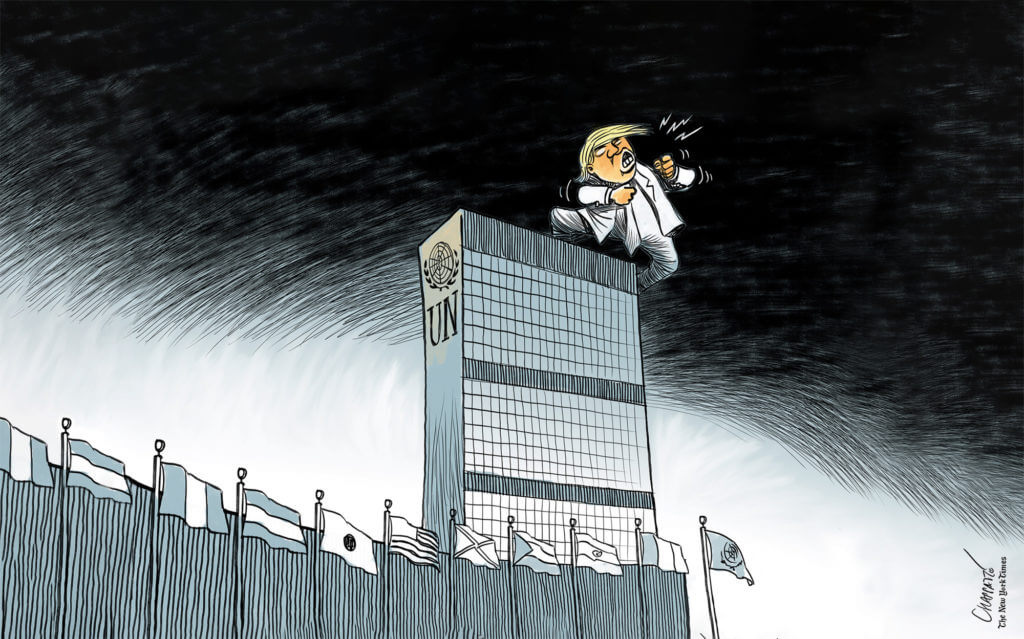
© Chappatte in Le Temps, Geneva
As images of conflict and atrocities multiply, a disturbing question resurfaces: do international treaties designed to protect civilians, prevent genocide and regulate the use of war still carry any weight? From the Convention on the Prevention of Genocide to the founding principles of humanitarian law, the legal edifice built after the Second World War is faltering. Between institutional paralysis, political manipulation and blatant impunity, there is a seeming “return to the law of the strongest”. Concurrently, the notion of genocide has gained traction again as it is mobilised by a wide range of actors to denounce Israel’s attack on Gaza and its lethal consequences since 7 October 2023.
This Dossier questions the capacity — and the limits — of international law in the face of contemporary violence. What is the current level of trust in the international legal architecture to address occurrences of mass violence? What is the relevance of the notion of genocide today, as opposed to that of war crimes or crimes against humanity? What are the political stakes in the use of terms that have a judicial grounding and are invested with historical meaning and precedents? In a world where legal landmarks are more necessary but also more contested than ever, the dossier offers valuable insights into these questions.
The present Dossier takes stock of the current state of the multilateral system and its future prospects. It aims to explore to what extent global governance is in crisis as the global geopolitical order is undergoing fundamental shifts and liberal universalism is losing traction. It assesses potential of reform in extant institutions as well as emerging trends, tools and forums that are reshaping multilateral practice on a daily basis.
Note – The dossier was drafted before the Covid-19 world crisis.
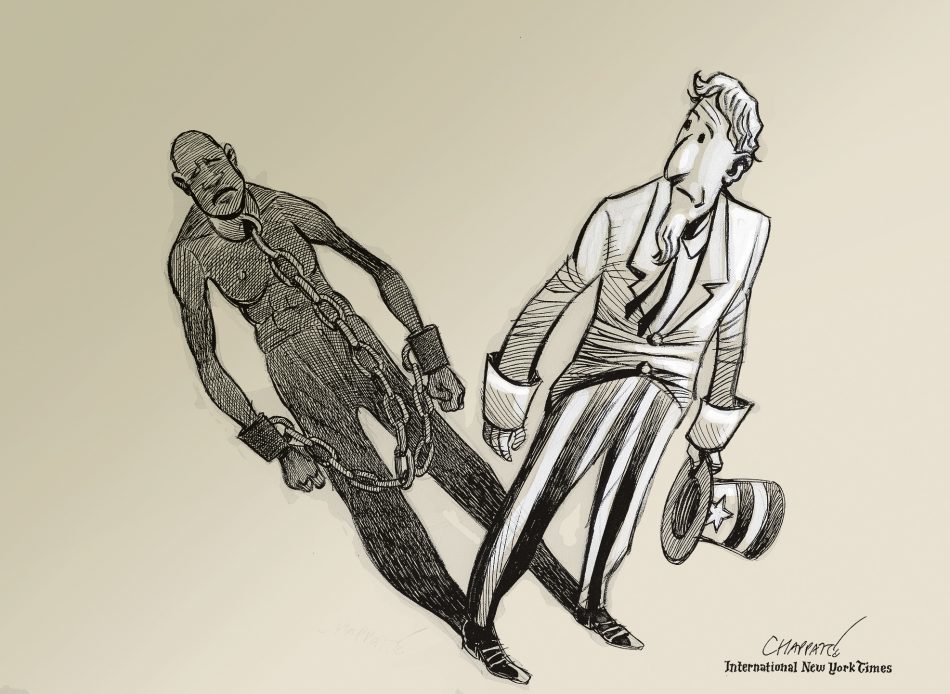
Today, we observe a renewed interest in the theme of decolonisation in three interrelated fields: in the academic world which opens new areas of research and teaching (e.g. decolonisation studies; decolonising the curriculum), in the practice of professionals and international actors who are revisiting their way of working, as well as in the vocabulary and activism of civil society targeting the remnants of colonial times such as street names, statues or museum objects. The renewed focus on decolonisation brings forth underlying issues such as the lingering of Eurocentrism, continued oppression of indigenous people, cultural relativism, the ongoing materiality of colonialism, the guilt of the West or, more generally, “the darker side of Western modernity”. While decolonisation has had a lasting impact on the political scene (with the decolonisation movements of the 1960s) and theoretically in the realm of academia, it lags behind in practice as processes, mentalities and epistemes are still permeated by “coloniality”. The present issue puts therefore decolonisation into historical perspective and provides fresh analytical perspectives on its epistemologies and methodologies as well as its practical application and consequences in various fields.
This issue has been coproduced by the Graduate Institute’s Department of International History and Politics and the Research Office. It also includes contributions from other research centres and departments of the Institute.
After a century marked by decolonisation and the imposition of a development model based on Western standards, Africa has entered the 21st century with a new status thanks, among other things, to its demographic dynamism (2 billion inhabitants in 2050 according to the UN, over 50% of whom will be under 25), its sustained economic growth, its extensive mineral and energy resources, and its drive for political leadership.
Additionally, since the end of the Cold War, emerging countries are successfully challenging the leadership of the West and are transforming this plural continent. If China has come to play a preponderant role, notably in terms of infrastructure development, the existence of multiple Africas presents prospects for a host of other international actors.
The continent’s development, however, is not without raising many questions, as it is still marked, in many ways, by issues of poverty and inequalities, as well as civil conflict and political repression.
The African continent is seeking more than ever to assert its autonomy of decision and action by making the most of its diverse potential. How will Africa – in its plural dimension – take advantage of this dynamism to write a new page in its history in the decades to come?