The Uncertain Future of Human Rights
PODCAST: The Universality of Human Rights with Huaru Kang
Global Challenges n° 11 (The Uncertain Future of Human Rights). With Dominic Eggel and Marc Galvin (Research Office – The Graduate Institute, Geneva)
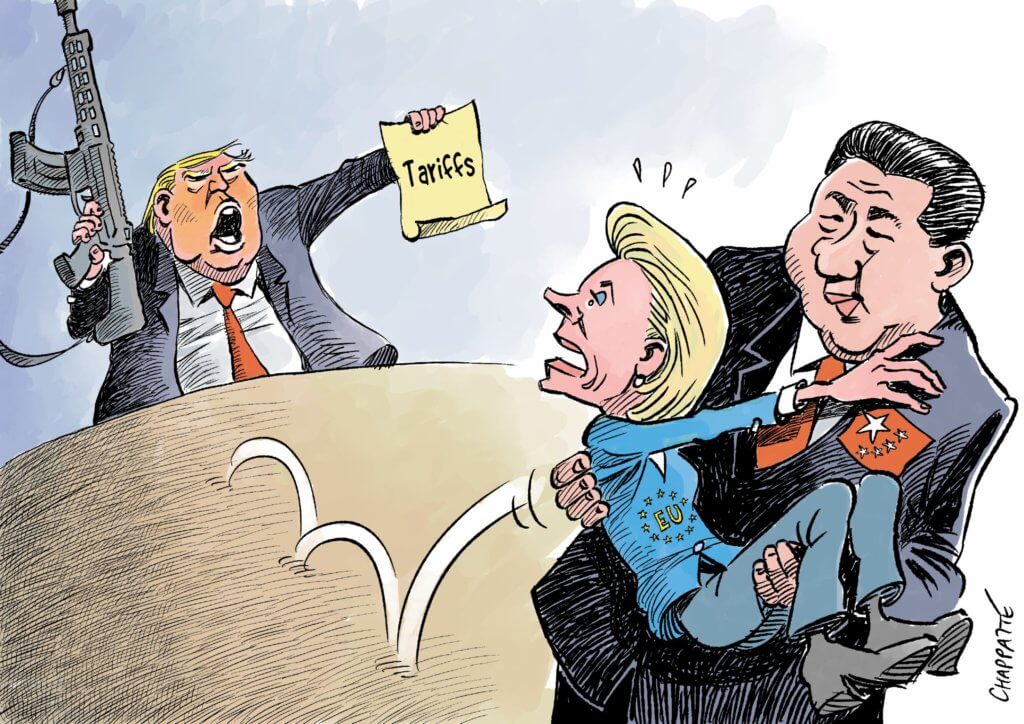
The multipolar world succeeding US hegemony in the early 21st century, the financial crisis of 2007 and the corollary decline of liberalism seem to have ushered in an era of economic nationalism. States are increasingly left to fend for themselves as multilateral mechanisms lose traction and international economic relations gain in toxicity. The sanctions, embargoes and retaliations arising from the war in Ukraine, but also an accelerating struggle for dwindling natural resources, have pushed these logics to new heights. This Dossier assesses ongoing geoeconomic transformations and their potentially devastating consequences.
While the 20th century has been characterised by the generalisation of democratisation processes, the 21st century seems to have started with the reverse trend. An authoritarian-populist nexus is threatening liberal democracy on a global scale, including in its American and European heartlands. Charismatic leaders – thriving on electoral majorities and popular referenda – methodically undermine the rule of law and constitutional safeguards in order to consolidate their own power basis. Coupling inflammatory rhetoric with modern communication technologies, they short-circuit traditional elites and refuse to abide by international norms. Agitating contemporary scourges such as insecurity, loss of identity, mass migration and corrupt elites, they put in place new laws and mechanisms to harness civil society and political opponents. In order to better understand the novelty, permanence and global reach of “illiberal democracy”, this second issue of Global Challenges proposes seven case studies (Russia, Hungary, Turkey, the Middle East, Uganda, Venezuela and the United States) complemented by a series of expert interviews, maps and infographics.
The present issue seeks to better apprehend the nature of this new era of digital disinformation and how it differs from prior eras marked by the dissemination of more traditional propaganda (notably the Cold War) or by the spread of American (or liberal) soft power through mass media and consumption. In so doing the issue seeks to address a series of questions such as: has traditional propaganda consisting in over-selling a model or ideology by means of manipulation and mass media been replaced by the generalisation of disinformation in the post-truth era characterized by systematic epistemic deconstruction and the outright discreditation of any truth claims? What is the role of states (as opposed to other actors) in this process and what tools and operational mechanisms are they mobilizing to pursue their global (dis-)information campaigns? What is the impact of the generalisation of alternative facts and disinformation campaigns on the international order? Who is to win and lose from it? What can be done, notably at the international level and the UN, to counter the noxious effects of global disinformation campaigns and to recreate trust in the global information order?