Loading...
Skip to content
IHEID

Sign up for email notification of new issue

Global Challenges
Issue no. 13 | May 2023
The Global Disinformation Order
The Global Disinformation Order | Figure for Article 4

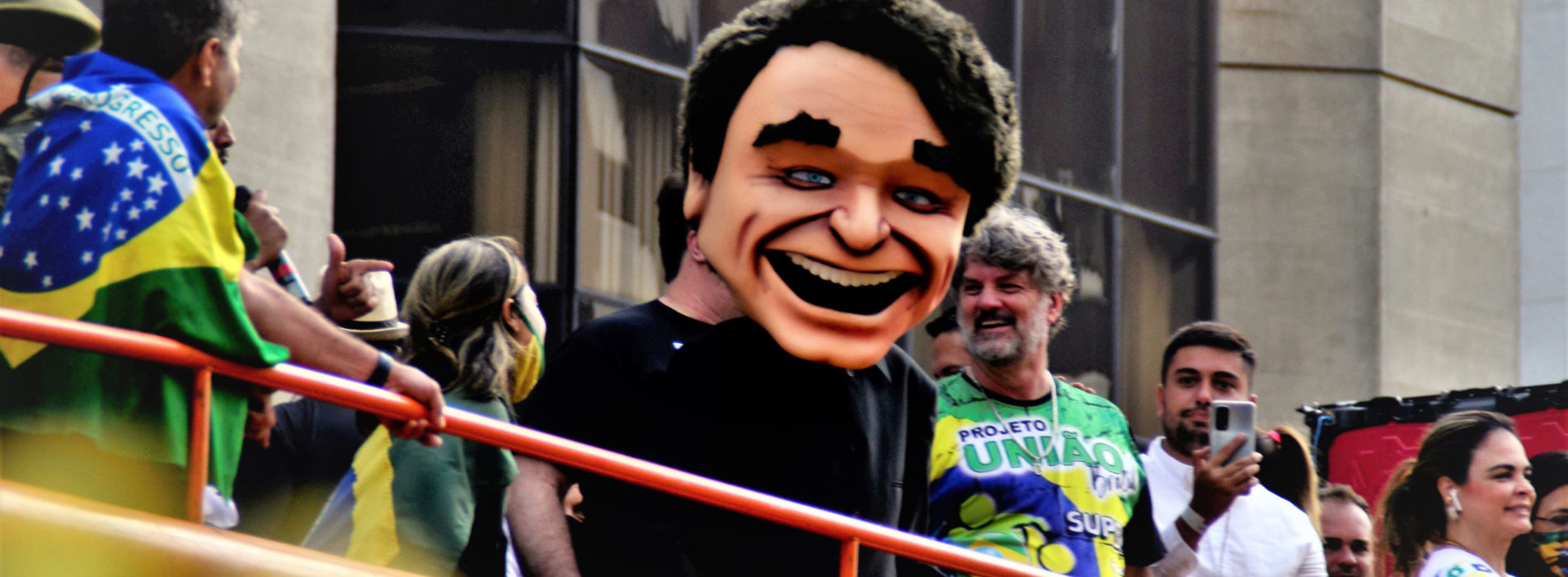
Vulgar Vibes: The Atmospheres of the Global Disinformation Order

Bolsonaro chanting “imbrochável” with the crowd

Stills from video recording available on www.youtube.com (accessed 3 April 2023).

Other Issues
Issue no. 16 | November 2024
image
Start reading
Elections – What For?
Global Challenges
Issue no. 16 | November 2024
Elections – What For?

In 2024, nearly half the world’s population, including citizens of the eight most populous nations, voted or will vote in elections. While this signals democratic engagement, many elections are run by autocratic or illiberal regimes pursuing self-serving agendas. Paradoxically thus, as elections are generalising as a practice, democracy is met with growing defiance. On closer scrutiny, however, it appears that it is not only the indicators of democracy but also those of elections that have been declining over the past decade. This dossier, produced with the Albert Hirschman Centre for Democracy, examines the essential role of elections in the construction of democracy today.

Start reading
Issue no. 8 | November 2020
image
Start reading
The New Frontiers of Risk
Global Challenges
Issue no. 8 | November 2020
The New Frontiers of Risk

After the outbreak of COVID-19 – a virus constituting a genuinely worldwide risk – fear internationalised in just a few weeks. As the COVID crisis has profoundly shaken societies on a global scale it has contributed to a reconfiguration – perhaps a multiplication – of risks and their perceptions. While foremost constituting a biological hazard, the pandemic has large repercussions on other types of risks, ranging from long-term economic and digital disruption to psychological distress and political confrontation. The nature and frontiers of risks are thus moving as the multilateral system, the most adequate framework to deal with global risks, is ailing and current risk mitigation strategies are increasingly put to question. The six articles of the present Dossier explore these changing hierarchies of risk and the underpinning structural issues that endanger our existence.

Start reading
Issue no. 5 | April 2019
image
Start reading
New Grammars of War:
Conflict and Violence in the 21st Century
Global Challenges
Issue no. 5 | April 2019
New Grammars of War: Conflict and Violence in the 21st Century

The Dossier aims to explore new trends and expressions of violence in armed conflict in the 21st century. Taking as a starting point the changing paradigm of armed conflict – from conventional wars with clear contours towards more non-linear, fragmented and protracted types of civil and international conflict — it adopts a broad approach to portray changing forms of violence across different types of armed conflicts (including terrorism, international/civil wars or urban warfare). In the context of a fragmenting international order, with increasingly blurred lines between state and non-state, combatant and civilian, domestic and international, the number of actors involved in conflicts and concurrent strategies of violence have multiplied. In face of the ubiquity of violent conflict — despite an overall decline in interstate conflict and global number of casualties — the Dossier aims to shed light on new or changing forms of violence, their contexts, actors and victims. It explores the novelty, heterogeneity, scales and vectors of violent practices in contemporary conflicts by investigating the impact of a series of factors such as new military technologies (drones, robots), new communication tools (social media), gender, migration, or the subcontracting of security to private actors.

Start reading

Sign up for the newsletter

© Global Challenges: Geneva Graduate Institute Dossiers

website by whybe.ch
We use cookies to ensure that we give you the best experience on our website. If you continue to use this site we will assume that you are happy with it.