The Future of Universities | Figure for the Issue
The Future of Universities
VIDEO: The UNESCO Chair in Comparative Education Policy, with Chanwoong Baek
Research Office, Geneva Graduate Institute.
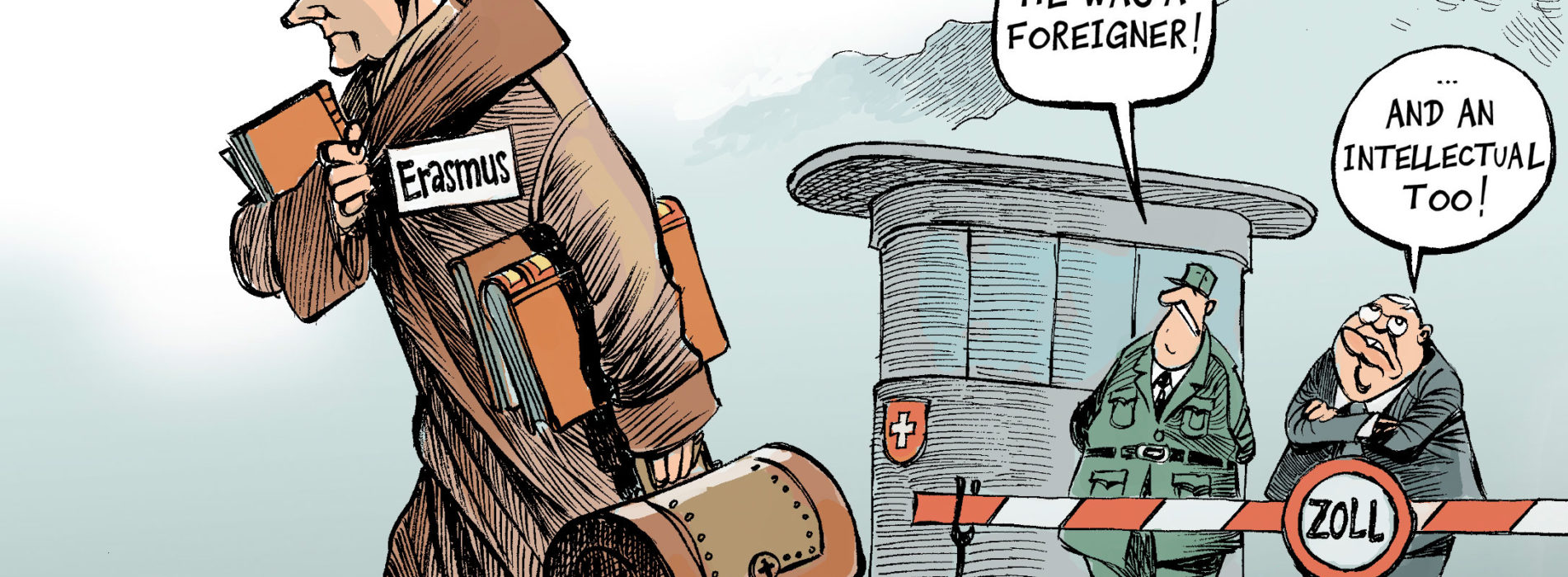
© Chappatte in Le Temps, Geneva
Research Office, Geneva Graduate Institute.
After a century marked by decolonisation and the imposition of a development model based on Western standards, Africa has entered the 21st century with a new status thanks, among other things, to its demographic dynamism (2 billion inhabitants in 2050 according to the UN, over 50% of whom will be under 25), its sustained economic growth, its extensive mineral and energy resources, and its drive for political leadership.
Additionally, since the end of the Cold War, emerging countries are successfully challenging the leadership of the West and are transforming this plural continent. If China has come to play a preponderant role, notably in terms of infrastructure development, the existence of multiple Africas presents prospects for a host of other international actors.
The continent’s development, however, is not without raising many questions, as it is still marked, in many ways, by issues of poverty and inequalities, as well as civil conflict and political repression.
The African continent is seeking more than ever to assert its autonomy of decision and action by making the most of its diverse potential. How will Africa – in its plural dimension – take advantage of this dynamism to write a new page in its history in the decades to come?
Neoliberal globalisation has not only transformed the role of the state; it has also shaken up the internal “DNA” of education policies, from schools to universities. New technologies have paved the way for new forms of transmitting knowledge; calls to decolonise curricula are growing louder; in the South, many countries face the challenge of financing public education policies in an era of new public management, while the model and transfer of these policies have become a key problem, compounded by the exclusion of historically marginalised populations and the advance of private and religious players. Against this backdrop of criticism of the public education model, the present Dossier seeks to better apprehend what could be done to restore the purpose and meaning of education and universities.
After the outbreak of COVID-19 – a virus constituting a genuinely worldwide risk – fear internationalised in just a few weeks. As the COVID crisis has profoundly shaken societies on a global scale it has contributed to a reconfiguration – perhaps a multiplication – of risks and their perceptions. While foremost constituting a biological hazard, the pandemic has large repercussions on other types of risks, ranging from long-term economic and digital disruption to psychological distress and political confrontation. The nature and frontiers of risks are thus moving as the multilateral system, the most adequate framework to deal with global risks, is ailing and current risk mitigation strategies are increasingly put to question. The six articles of the present Dossier explore these changing hierarchies of risk and the underpinning structural issues that endanger our existence.