















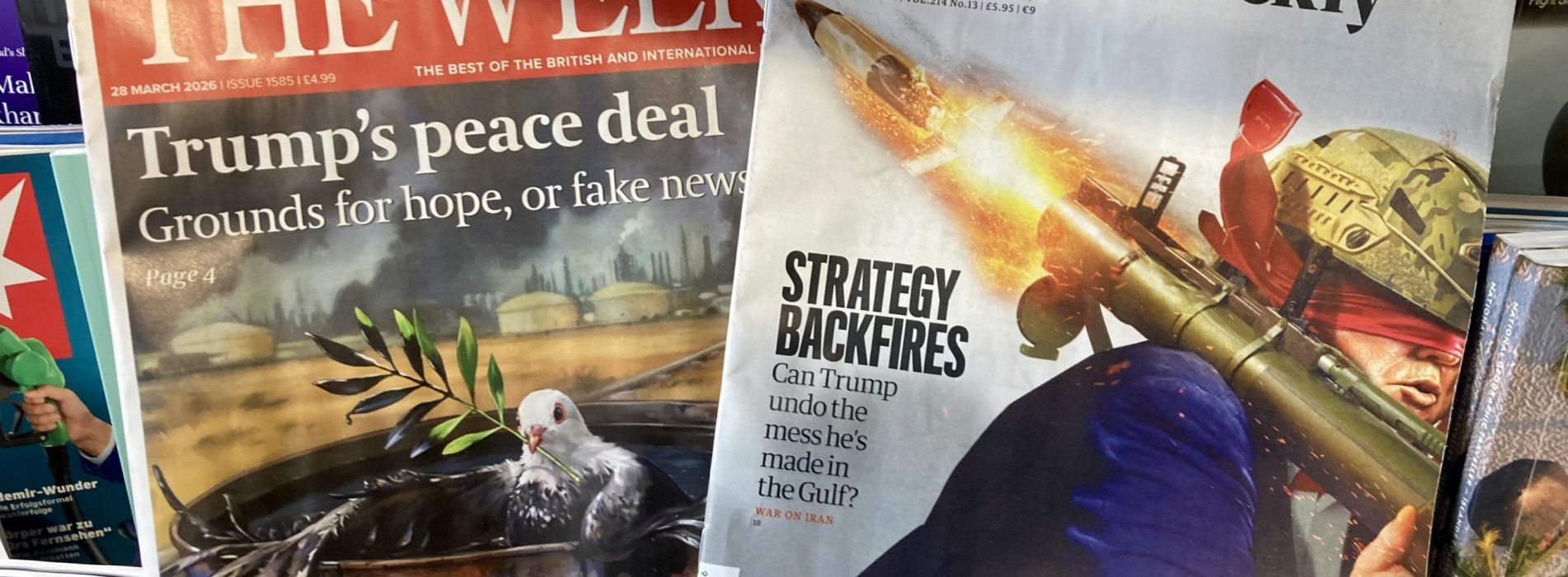
A “Small World War” in the Middle East
Call it a small world war. The 40-day war that the United States and Israel launched against Iran in February 2026 was fought in a single region, but across several linked theatres, drew in powers well beyond the three main belligerents, and now shakes the global order the way only a world war once did.
Consider the theatres. There was the direct Gulf theatre, where Iran struck vulnerable US military infrastructure and, notably, civilian targets in Gulf states hosting American bases — punishing neighbours, chiefly the UAE, but also other countries, for hosting US forces and for their ties to Israel. There was the Levant theatre, where Israel’s war on Hezbollah in Lebanon ran in parallel, and which Tehran explicitly linked to the Gulf theatre through a menacing if-then logic: if Israel keeps striking Beirut and south Lebanon, Iran may hit US targets in the Gulf; if Israel hits Iran’s oil facilities, Iran will hit Arab ones. And there was the maritime-economic theatre: Iran’s closure of the Strait of Hormuz, which turned a regional war into a global economic shock, driving up oil and food prices worldwide.
Consider, too, the actors. Formally this was a war between a US-Israeli alliance and Iran. But it entangled Gulf states as targets, as hosts of contested US bases, and, increasingly, as co-negotiators alongside Pakistan in the ensuing US-Iran talks. It entangled global energy markets and, through them, much of the world economy. It entangled China, benefiting as the emerging rival superpower from Washington’s self-inflicted overextension. And it economically if not existentially punished poor people in various countries in the Global South.
This war echoes far beyond the Middle East, then. One should note that historically, a Gulf crisis has marked a turning point in America’s global position already twice before: in 1979, when Iran’s revolution and the humiliating hostage-taking of US embassy staff, compounded by the Soviet invasion of Afghanistan, produced the Carter Doctrine and made the Gulf Washington’s chief arena of power projection; and in 1990–91, when Washington’s response to Iraq’s invasion of Kuwait displayed, with maximal effect, its new unipolar primacy as the Cold War ended. Today, developments in the Gulf are again accelerating a shift already underway in global power — this time from a fading unipolar order into an emerging multipolar one, complete with a new superpower rival.
Tehran, thanks to Hormuz, wields something it lacked before: genuine global leverage over Washington. The differences from 1979 and 1990 matter, though. Then, crises were triggered regionally, by Iran and by Iraq; now the trigger is Washington’s own war. And Tehran, thanks to Hormuz, wields something it lacked before: genuine global leverage over Washington. Accordingly, Iran has entered post-ceasefire negotiations not despite having fought, but through what its own negotiators call “combat diplomacy” (diplomasi-ye mobarezeh): talking and striking simultaneously, using calibrated military signals — drone strikes, Hormuz threats — to enforce its own reading of the June 2026 Memorandum of Understanding. In Tehran’s logic, credible deterrence is the precondition, not the alternative, of successful negotiation with an adversary it fundamentally distrusts. The approach has a domestic function too: it is the compromise formula between Iranian “pragmatists” and “hardliners”, and ideologically it inoculates both against ultra-hardliners who reject any talks as capitulation, folding diplomacy itself into an unbroken revolutionary struggle against the United States.
Yet combat diplomacy carries a structural flaw. Like all coercive diplomacy, it ultimately rests on raw force, which is legitimate to no one and therefore unstable. Durable power requires accommodating others’ interests, at least minimally. The question, then, is whether Iran can sustain credible deterrence and negotiate sanctions relief and economic normalisation its exhausted, dissent-wracked economy urgently needs and, perhaps most importantly, create a new security architecture that is minimally acceptable to its Arab Gulf neighbours in the Gulf. That tension — together with Emirati resistance to further US concessions and Israel’s own uncertain willingness to accept a deal negotiated over its head — keeps the region in an unstable no-deal limbo: Tehran confident yet aggrieved, Washington flailing between escalation and appeasement, Israel caught between obeying Trump and looking weak before its own elections.
combat diplomacy carries a structural flaw. Like all coercive diplomacy, it ultimately rests on raw force, which is legitimate to no one and therefore unstable. What is already shifting, deal or no deal, is the regional order built after 1979. For one thing, Washington is somewhat hardening its posture toward Israel — a shift with precedent in the Obama-era 2013–15 talks, but potentially more durable now given rising Israel-sceptic voices even within the Republican camp. And for another thing, Gulf states, trusting Washington’s guarantees less than before yet still needing them, are moving from mere mediators to active participants, alongside Pakistan, in shaping a security architecture meant to include, not just contain, Iran.
The stakes of this small world war’s aftermath are therefore not small at all. Handled badly, it becomes what it already resembles: a chronic, multi-front, multi-actor confrontation that periodically convulses global energy markets and accelerates America’s relative decline. Handled well — should Washington finally trade its half-century of costly Gulf over-investment for a genuine deal — the same crisis could free up resources and attention for the “pivot to Asia” that has eluded Washington since Obama first announced it, at the very moment that pivot matters most.
Electronic reference
Schayegh, Cyrus . “A ‘Small World War’ in the Middle East.” Global Challenges, no. 20, October 2026. URL: https://globalchallenges.ch/issue/20/a-small-world-war-in-the-middle-east.Anticipating the many events that will mark the Institute’s Centenary in 2027, this issue is the first instalment of a special double issue on war and peace, to be followed next spring by a second part focusing on peace and the dynamics of its necessary re-affirmation. Edited by Professor Andrew Clapham and produced by the Research Office, it was first published in Le Temps in September 2026.
TABLE | Trends in the 10 Largest Military Budgets (billions of US dollars)
| Country | 2020 | 2024 | 2026 (estimation) |
|---|---|---|---|
| USA | 778 | 968 | > 1000 |
| China | 252 | 318 | 360 |
| Russia | 62 | 150 | 200 |
| Germany | 53 | 86 | 120 |
| India | 73 | 86 | 98 |
| UK | 70 | 91 | 92 |
| Ukraine | 6 | 70 | 95 |
| Saudi Arabia | 57 | 82 | 85 |
| France | 53 | 67 | 72 |
| Japan | 49 | 57 | 68 |
In 2025, the top three military powers (the United States, China, and Russia) spent a total of USD 1,480 billion, representing more than half of global military spending. Germany was Europe’s largest military spender with USD 114 billion, significantly surpassing France and the United Kingdom.
Source: SIPRI, https://www.sipri.org. Table produced by the Geneva Graduate Institute’s Research Office.
© Geneva Academy of International Humanitarian Law and Human Rights
PODCAST: War WATCH – Ukraine: The Human Cost of Drones
Episode 6 of the War Watch series (Geneva Academy).
PODCAST | The future of European security
Research Office – Geneva Graduate Institute
PODCAST | War WATCH: the portal that tracks armed conflicts worldwide
Research Office – Geneva Graduate Institute