











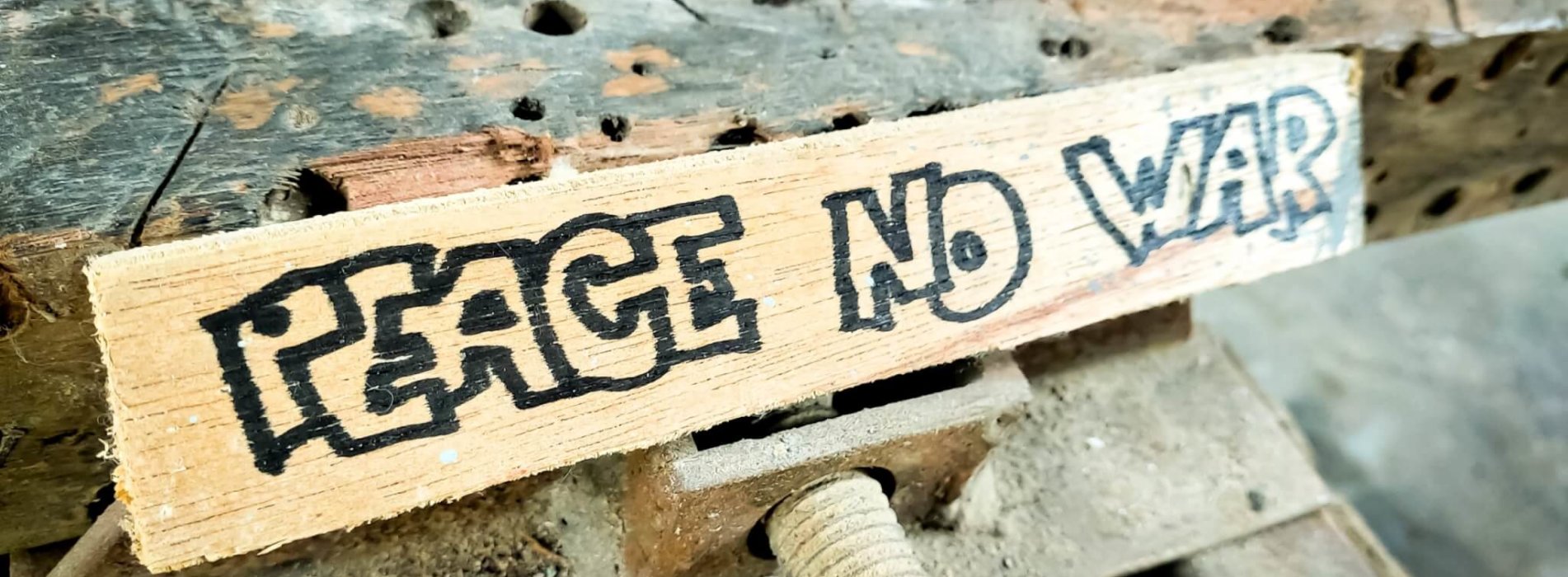
Talking about War and Peace
Today there is a paradox when leaders talk about war. The concept of war is relied on to strike fear in the minds of the enemy and to rally the population around a nation in times of emergency. One only has to think of the conversion last year of the US Department of Defense into a Department of War with the claim by the newly titled Secretary of War that “we’re going to raise up warriors, not just defenders”. But at the same time, leaders have to avoid the implication that the state is “at war” because this raises questions of accountability and the legitimacy of the military action. So in order to avoid the implications of the War Powers Act, President Trump may describe the action against Iran as an “excursion”, and yet when pressed he admits “for them it’s a war”. Famously, you can be punished in Moscow for referring to the special military operation in Ukraine as a “war”. The idea of war is too reminiscent of mothers sacrificing their conscripted sons and suggests a fight between equal sovereign states. And yet for those being killed on all sides, this is war.
When it comes to justifying and excusing the death and destruction, the language of war is easily deployed again; repeatedly, leaders respond to queries about civilian casualties or questionable destruction by referencing the “fog of war”. President Trump even warned that Americans could die at home, simply stating, “When you go to war, some people will die.” This fatalism in the face of war was repeated over and over in the context of Gaza. President Biden was initially dismissive of Palestinian figures of civilian deaths: “I’m sure innocents have been killed, and it’s the price of waging a war.” An ex-London schoolboy turned Israeli soldier addressed the critics in these words: “I understand why the British public and government would be concerned by such a high death toll. But you have to understand the circumstances surrounding that and why the numbers are so high. It’s a war zone. People die in war. Just like many Germans died in World War Two.”
The effects of these wars on the rest of the world are apparent: spikes in oil prices, disruption of delivery of essential fertiliser, food insecurity, environmental damage, young men and women leaving their families to head off to foreign lands only to be senselessly slaughtered in someone else’s war, thousands of seafarers stranded for months in the Strait of Hormuz. And yet the rest of the world is strangely passive. Passive, not pacifist. In fact, perhaps we should not expect the whole world to be pacifist, but we should expect more pacificism in the active sense used by Émile Arnaud when he proposed a name for the Peace Movement:
“Aucun des mots du dictionnaire n’est adéquat à notre programme. Nous ne sommes pas seulement des ‘pacifiques’, nous ne sommes pas seulement des ‘pacifiants’, nous ne sommes pas seulement des ‘pacificateurs’. Nous sommes le tout à la fois, et autre chose encore : nous sommes, en un mot, des Pacifistes. Et d’ailleurs, pour désigner notre parti il nous faut un mot en isme comme au royalisme, au bonapartisme, à l’impérialisme, au républicanisme, au radicalisme, à l’opportunisme, au progressisme, au socialisme, au collectivisme, à l’anarchisme, comme au christianisme, au catholicisme, au protestantisme. Et ce nom, tout naturel, mais qui n’a jamais été, à notre connaissance du moins, employé jusqu’ici, c’est: Le Pacifisme.”
What happened to the spirit of active pacificism? Where are the Peace Movements? As defined by Arnaud in 1906, “le Pacifisme est la bannière sous laquelle se groupent les humains qui, désireux d’assurer, par la suppression de la guerre, le respect de la vie humaine et de l’autonomie des Peuples, recherchent les meilleurs moyens d’organiser la Paix et la Justice entre Nations, et, ces moyens trouvés, font tous leurs efforts pour en hâter l’application.”
What happened to the spirit of active pacificism? Where are the Peace Movements? It is not enough simply to say “no to war”, to remain passive and inert, or, dare we say it, “neutral”. Pacificism, in the sense used in more modern times by A.J.P Taylor and Martin Ceadel, is not the same as pacifism: “Pacificists are those who favour peaceful foreign policies and who seek to develop international institutions for the promotion of peace. Pacifism in its pure form is a total rejection of war as an instrument of policy.”
Not only are we witnessing the simultaneous invocation of war as an excuse for violence along with the denial that anyone should be accountable for choosing the war path, but we are also hearing a lot of talk about how the deaths of civilians and the destruction of civilian infrastructure are legitimate (even legal) due to their connection to the war-fighting capacity of the enemy. Merchant ships, bridges, railways, ports, fuel depots, hospitals and warehouses are too easily spuriously labelled as “dual use” or simply military objectives. When talking about the bombing of Iran, the vocabulary is remarkable; we find the familiar threats of retaliation and decimation, but also the frightening promises of obliteration, elimination and annihilation.
Challenging resort to war and the failure to respect the minimal laws of war leads to accusations of treason, treachery, or sedition and to critics being labelled as “traitors”. Challenging resort to war and the failure to respect the minimal laws of war leads to accusations of treason, treachery, or sedition and to critics being labelled as “traitors”. As quipped by Dmitry Kisiev from Moscow, “Whereas previously it was forbidden to speak out against the war, now it is forbidden even to simply speak out in favour of peace.” Suggestions by the International Criminal Court that leaders or commanders should be arrested for killings in Afghanistan, the deportation of children from Ukraine, or the killing of aid workers and the starvation of civilians in Palestine have been met with trials in absentia in Moscow and sanctions from Washington. We are losing the ability to even talk about war crimes, let alone do anything about them. If we fail, to paraphrase Arnaud, to do everything we can to organise Peace and Justice, we risk returning to a time when, in the words of Thucydides, “the strong do what they can, and the weak suffer what they must”. We should not relapse into the idea that wars are like thunderstorms, something to be weathered but beyond human control. There is a dangerous fatalism in the air. On the first day of the bombing of Iran earlier this year, an airstrike killed 175 people in a school. Questions have been raised. These have been curtly dismissed by President Trump, who simply stated: “Mistakes are made. War is nasty.” It’s time to speak out against nastiness and stand up for Peace.
Electronic reference
Clapham, Andrew. “Talking about War and Peace.” Global Challenges, no. 20, October 2026. URL: https://globalchallenges.ch/issue/20/talking-about-war-and-peace.Anticipating the many events that will mark the Institute’s Centenary in 2027, this issue is the first instalment of a special double issue on war and peace, to be followed next spring by a second part focusing on peace and the dynamics of its necessary re-affirmation. Edited by Professor Andrew Clapham and produced by the Research Office, it was first published in Le Temps in September 2026.
TABLE | Trends in the 10 Largest Military Budgets (billions of US dollars)
| Country | 2020 | 2024 | 2026 (estimation) |
|---|---|---|---|
| USA | 778 | 968 | > 1000 |
| China | 252 | 318 | 360 |
| Russia | 62 | 150 | 200 |
| Germany | 53 | 86 | 120 |
| India | 73 | 86 | 98 |
| UK | 70 | 91 | 92 |
| Ukraine | 6 | 70 | 95 |
| Saudi Arabia | 57 | 82 | 85 |
| France | 53 | 67 | 72 |
| Japan | 49 | 57 | 68 |
In 2025, the top three military powers (the United States, China, and Russia) spent a total of USD 1,480 billion, representing more than half of global military spending. Germany was Europe’s largest military spender with USD 114 billion, significantly surpassing France and the United Kingdom.
Source: SIPRI, https://www.sipri.org. Table produced by the Geneva Graduate Institute’s Research Office.
© Geneva Academy of International Humanitarian Law and Human Rights
PODCAST: War WATCH – Ukraine: The Human Cost of Drones
Episode 6 of the War Watch series (Geneva Academy).
PODCAST | The future of European security
Research Office – Geneva Graduate Institute
PODCAST | War WATCH: the portal that tracks armed conflicts worldwide
Research Office – Geneva Graduate Institute