















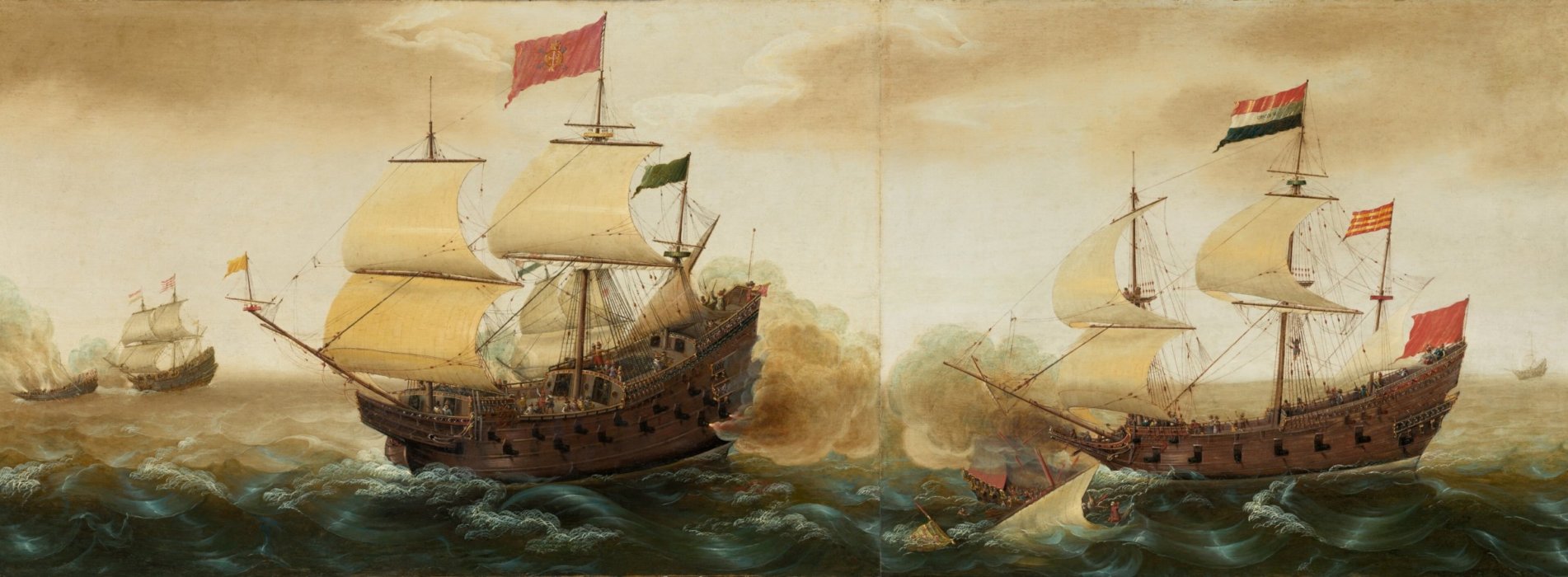
Seapower in a Disordered World
The maritime domain is key to national security and economic prosperity. Battles are generally won on land, but systemic wars and global leadership challenges are won at sea. Mastering the global ocean facilitates the projection of military power across the world, as well as controlling the flow of goods at sea.
Seapower infers a positive correlation between sea mastery and global dominance, but it transcends naval power to include economic, civilian, and ideational forms of power at various economic, political, legal and strategic scales. First, naval power enables states to project forces and power for deterrence or offensive purposes but also, and perhaps more importantly, to control sea lanes of communication and maritime supply chains. Second, civilian maritime power reflects states’ ability to influence or lead economic stakeholders such as ports, shipyards, shipping companies, and maritime insurances. Thirdly, ideational seapower accounts for the existence, at the higher level of decision-making, of a maritime strategic culture, an understanding of the importance of the sea, and the willingness to devote resources to developing seapower; it also reflects a state’s ability to shape political, legal and institutional mechanisms of ocean governance. Seapower therefore matters not only because it enables naval operations, but also because it determines who can secure flows, protect infrastructures, shape rules and sustain systemic leadership.
Since the Age of Discovery, European powers, and after the Second World War the collective West, have dominated the global maritime order. This mastery of the sea has underpinned their leadership of the international system and, in turn, has been central to their security and prosperity that depend heavily on the stability of the global maritime supply chain and thus on freedom of navigation. Today, seapower is, and will continue to be, a critical tool in the delivery of national security, economic resilience and global influence.
A Hotspot for “Grey Zone” Activities
However, recent systemic changes have produced a more disordered international order, defined by what I term “strategic acceleration” across three interconnected dimensions: geopolitics, technology, and climate change. In geopolitical terms, the post-war status quo is increasingly contested and disrupted, including through the use of force in violation of the UN Charter. In technological terms, the speed of innovation is challenging established doctrines and operational concepts, while empowering disruptors and malign actors to exploit asymmetric modes of warfare, including aerial and sea drones as well as cyber-attacks, that lower the cost of offensive action relative to defence. In environmental terms, climate change is affecting military assets, personnel, and operations, while also altering patterns of adversarial behaviour. These three “accelerations” reinforce one another, rendering the maritime domain less stable, more contested, and more vulnerable to disruption.
The maritime domain is particularly conducive to grey zone activities and hybrid warfare. The maritime domain is particularly conducive to grey zone activities and hybrid warfare. As a vast, fluid and partially opaque space, it is difficult to monitor and cannot be controlled or occupied in the same way as land. Jurisdictions are often overlapping, contested or weakly enforced, while maritime activities are embedded in complex transnational chains of ownership, registration, crewing and operation. These characteristics create favourable conditions for malign actors to conduct hostile but sub-threshold activities while plausibly denying responsibility, thereby complicating attribution, accountability and deterrence. Critical maritime infrastructure is especially vulnerable in this context. Undersea communication cables, pipelines, energy connectors, offshore installations, ports and landing stations are not merely physical assets; they are part of wider cyber-physical and transnational systems on which Western security, prosperity and digital sovereignty depend. As a result, grey zone activities at sea increasingly include the mapping of critical undersea infrastructure, interference with data flows, and attacks or suspected attacks on communication cables. These activities do not simply threaten connectivity; they are designed to generate uncertainty, test Western responses, and undermine societal resilience without necessarily crossing the threshold of armed conflict. Therefore, the strategic challenge is not only to protect vulnerable assets but to reduce the permissiveness of the maritime grey zone by improving maritime domain awareness, strengthening resilience, and limiting the space for plausible deniability by proactively countering hybrid activities.
Great Power Competition
Western maritime superiority is increasingly contested by a combination of great power competition, asymmetric disruption and grey zone activities. Western maritime superiority is increasingly contested by a combination of great power competition, asymmetric disruption and grey zone activities. China is developing and exercising seapower on a global scale, challenging Western assumptions about maritime dominance and freedom of manoeuvre. Iran and its proxies, by contrast, exploit geography and asymmetric capabilities to threaten the free flow of energy and goods through maritime chokepoints, with consequences for energy prices, financial markets and the wider prosperity of Western societies. Russia operates through yet another register: it acts aggressively in and around European waters, collecting intelligence, mapping critical undersea infrastructure and probing the limits of Western deterrence. Through its “shadow fleet”, it also exploits the legal and commercial opacity of global shipping to circumvent sanctions and sustain hybrid pressure. Together, these developments show that Western seapower is being challenged not only through naval competition, but also through asymmetric, hybrid and sub-threshold activities at sea. The strategic effect of such activities lies not only in material disruption, but also in the uncertainty they generate. Indeed, by unsettling global markets, weakening societal cohesion and complicating timely political response, grey zone operations and maritime disruptions erode the credibility of Western governments and degrade their ability to respond decisively to security threats.
The future of the global order will be decided, to a significant extent, at sea. Maritime dominance has long enabled European powers, and later the collective West, to shape the rules, institutions and practices of the international order. If Western nations lose that dominance, the result is unlikely to be a leaderless maritime domain. Rather, it may be the emergence of a more illiberal order, shaped increasingly by Chinese power and preferences, but also by the actions of revisionist states, disruptive non-state actors and private control over critical infrastructures.
Yet China’s dependence on seaborne trade means that Beijing has little interest in making the global maritime order fundamentally insecure. Yet China’s dependence on seaborne trade means that Beijing has little interest in making the global maritime order fundamentally insecure. Its objective is not disruption for its own sake, but control: control over rules, routes, infrastructures and strategic access. China will seek to secure its trade, protect its sea lanes of communication and project power in support of its interests, much as previous maritime hegemons have done. The central question, therefore, is not whether the maritime order will survive, but who will define its rules and who will possess the power to enforce them.
Electronic reference
Germond, Basil. “Seapower in a Disordered World.” Global Challenges, no. 20, October 2026. URL: https://globalchallenges.ch/issue/20/seapower-in-a-disordered-world.Anticipating the many events that will mark the Institute’s Centenary in 2027, this issue is the first instalment of a special double issue on war and peace, to be followed next spring by a second part focusing on peace and the dynamics of its necessary re-affirmation. Edited by Professor Andrew Clapham and produced by the Research Office, it was first published in Le Temps in September 2026.
TABLE | Trends in the 10 Largest Military Budgets (billions of US dollars)
| Country | 2020 | 2024 | 2026 (estimation) |
|---|---|---|---|
| USA | 778 | 968 | > 1000 |
| China | 252 | 318 | 360 |
| Russia | 62 | 150 | 200 |
| Germany | 53 | 86 | 120 |
| India | 73 | 86 | 98 |
| UK | 70 | 91 | 92 |
| Ukraine | 6 | 70 | 95 |
| Saudi Arabia | 57 | 82 | 85 |
| France | 53 | 67 | 72 |
| Japan | 49 | 57 | 68 |
In 2025, the top three military powers (the United States, China, and Russia) spent a total of USD 1,480 billion, representing more than half of global military spending. Germany was Europe’s largest military spender with USD 114 billion, significantly surpassing France and the United Kingdom.
Source: SIPRI, https://www.sipri.org. Table produced by the Geneva Graduate Institute’s Research Office.
© Geneva Academy of International Humanitarian Law and Human Rights
PODCAST: War WATCH – Ukraine: The Human Cost of Drones
Episode 6 of the War Watch series (Geneva Academy).
PODCAST | The future of European security
Research Office – Geneva Graduate Institute
PODCAST | War WATCH: the portal that tracks armed conflicts worldwide
Research Office – Geneva Graduate Institute