











Weaponising the “Peaceful Atom”
On 26 April 2026, Ukraine marked 40 years since the Chornobyl disaster. Once associated with the worst catastrophe of the nuclear age, Ukraine is again at the centre of a global nuclear crisis, but of a different kind. The danger now lies not only in military escalation or new accident, but in the transformation of civilian nuclear infrastructure into an instrument of war — a possibility for which the international nuclear order remains ill-prepared.
In the early hours of 26 April 1986, during a safety test at reactor no. 4 of the Chornobyl Nuclear Power Plant, operational errors and design flaws triggered two explosions, destroying the reactor core. While radioactive particles were spreading across Europe, Soviet authorities were trying to conceal the disaster, maintaining an appearance of normality. In Kyiv, the May Day parade went ahead despite rising radiation levels, while the public received little information about exposure or protection. Mikhail Gorbachev, despite his devotion to glasnost (transparency), did not address Soviet citizens until 14 May. The information became public only when unusually high radiation levels were detected at the Forsmark nuclear plant in Sweden. The catastrophe thus became synonymous with the authoritarian information control and institutional unaccountability of the late Soviet state.
Its consequences reshaped both Ukraine’s political trajectory and international approaches to nuclear risk. As the historian Serhii Plokhy has argued, secrecy deepened the crisis of Soviet legitimacy and helped turn first waves of environmental mobilisation into broader demands for accountability and, eventually, independence. Internationally, the disaster accelerated new transnational mechanisms of nuclear cooperation and safety governance: the 1986 Convention on Early Notification of a Nuclear Accident, culminating in the 1994 Convention on Nuclear Safety.
Two Faces of the Same Atom
The civilian and military atoms are therefore less two separate branches than two differentiated faces of the same technological complex. The distinction between the military and civilian atom has been fundamental to international nuclear politics since the beginning of the atomic age. Eisenhower’s 1953 “Atoms for Peace” speech sought to recast atomic power from a technology associated with unprecedented destruction into one serving purposes of energy production and development. The institutional architecture that followed, including the creation of the International Atomic Energy Agency in 1957, sought both to promote these peaceful uses and to prevent civilian nuclear technologies from being diverted towards weapons.
Yet the boundary between the two uses of the atom was never as clear as this rhetoric suggested. Civilian and military nuclear programmes emerged from the same scientific discoveries and continued to share expertise, materials, technologies and institutions. The civilian and military atoms are therefore less two separate branches than two differentiated faces of the same technological complex.
This distinction nevertheless became foundational to the international nuclear order, institutionalised by the 1968 Nuclear Non-Proliferation Treaty (NPT): nuclear-weapon states retained their arsenals while non-nuclear-weapon states renounced acquiring them, alongside commitments to disarmament and the right to develop nuclear energy for peaceful purposes.
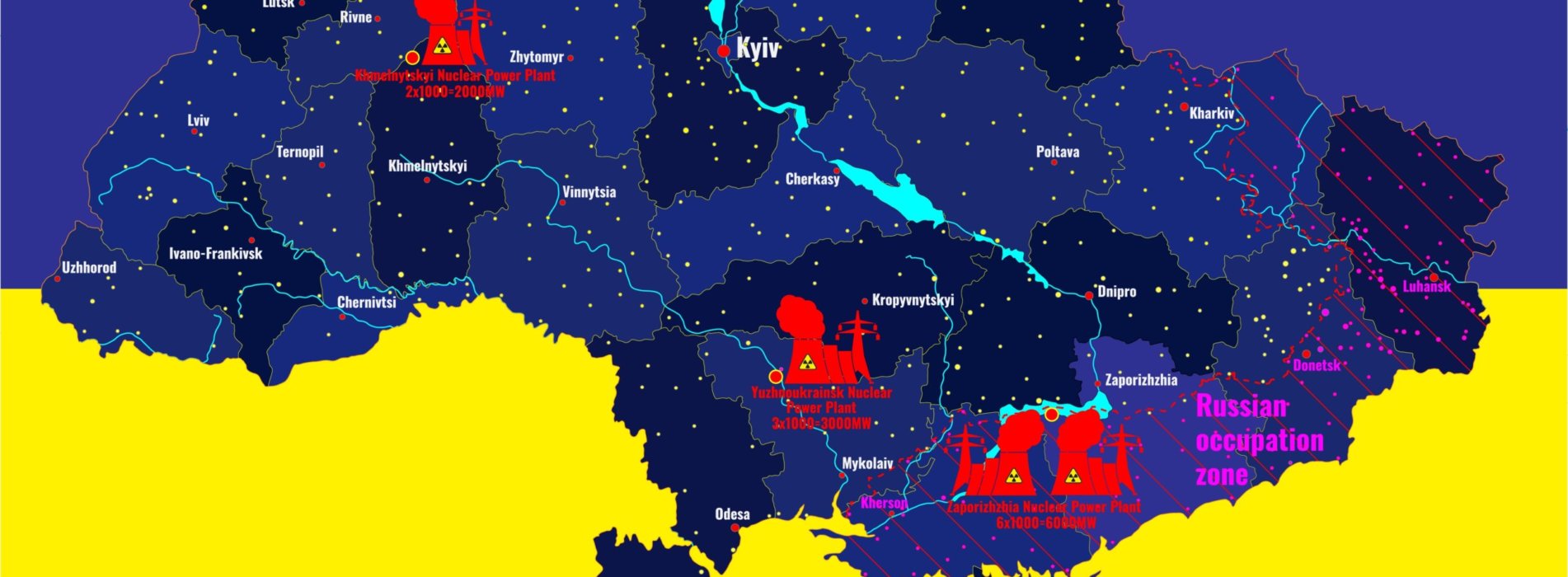
Ukraine embodies the contradictions of this order particularly starkly. With the collapse of the Soviet Union in 1991, it inherited a vast Soviet nuclear arsenal on its territory but subsequently acceded to the NPT as a non-nuclear-weapon state. This process of denuclearisation was sealed in 1994 by the Budapest Memorandum on security, violated in 2014 by Russia. Ukraine’s place in the post-Cold War nuclear order was thus founded on a profound asymmetry: relinquishing the military atom for the benefit of Russia, while retaining, and becoming increasingly dependent upon, the civilian one. Before the full-scale invasion, 15 reactors across four plants generated more than half of Ukraine’s electricity.
Then, in 2022, war came to the reactors.
A War inside a Nuclear Landscape
On 24 February, Russian troops entered the Chornobyl Exclusion Zone: heavy military vehicles moved through contaminated terrain, soldiers dug trenches in the radioactive Red Forest, while also damaging or looting laboratory and monitoring equipment. During this time, Ukrainian personnel remained at work. Maintaining safety systems — even while instructing occupying soldiers about nuclear risks — became a form of civilian defence.
On 4 March, Russian forces seized the Zaporizhzhia Nuclear Power Plant in Enerhodar, Europe’s largest nuclear power station. Before the invasion, its six reactors generated roughly one quarter of Ukraine’s electricity. Unlike Chornobyl, this was not a relic of the Soviet nuclear era but a central component of the country’s energy system.
As a city, Enerhodar was conceived around energy production. Taking control of the station therefore meant acquiring leverage over an entire social environment. Initially, the Ukrainian administration continued to function, as people demonstrated against the occupation, but by spring 2022 Russian authorities were replacing them and repressing resistance. Soon, Europe’s largest nuclear station was progressively incorporated into the mechanics of occupation.
This is where the story moves beyond military strategy into a more difficult institutional terrain. As described in detail by a recent report, Rosatom, Russia’s state nuclear corporation, became deeply involved in administering the Zaporizhzhia NPP and Enerhodar. Plant employees were pressured to sign contracts with Russian structures, while municipal services were incorporated into systems resembling Russia’s nuclear “atomic cities”, a Soviet-inherited model intertwining nuclear production, urban administration and social infrastructure.
Rosatom is neither simply a private company nor an ordinary state agency. It belongs to the Russian legal category of the “state corporation”: an organisation with considerable operational autonomy that remains deeply integrated into the state and connected to Russia’s security apparatus, including its Federal Security Service (FSB). The occupation of southern Ukraine thus exposes how unstable the civilian vs military distinction can become. A corporation providing the expertise needed to keep a nuclear installation safe can simultaneously help incorporate that installation — and the city around it — into an occupying state’s administrative system.
This matters far beyond Ukraine because Rosatom remains a major global nuclear actor, with projects extending across Armenia, Bangladesh, Belarus, China, Egypt, Hungary, India, Iran and Türkiye, while new agreements and negotiations continue in countries including Kazakhstan, Azerbaijan, Burkina Faso, Guinea, Myanmar, and Zimbabwe, among others. Its international position has remained remarkably resilient since the full-scale invasion: by 2024, its annual revenue had grown by 24%.
Nuclear Rules for a World at War
International law recognises the exceptional dangers associated with nuclear generating stations, surrounded by safeguards, inspections and safety regulations. Yet this architecture was not designed for prolonged military occupation.
In the past, attempts to clarify the international legal rules governing attacks on nuclear facilities have repeatedly stopped short of consensus. At the 1985 Review Conference of the Nuclear NPT, states nevertheless recognised that an armed attack on a nuclear facility “would create a situation in which the Security Council would have to act immediately” under the UN Charter. What remained unresolved was the question of how the system should respond when the threat to a nuclear facility comes from a permanent member of the Security Council itself.
Since 2022, Ukraine has turned this theoretical question into an urgent practical one.
Today, more than 400 nuclear power reactors operate around the world, while dozens more are under construction. Nuclear energy is simultaneously being reconsidered in many countries as part of strategies for decarbonisation and energy security. If nuclear power is to expand in an increasingly unstable geopolitical environment, international institutions will need to think much more seriously about how civilian nuclear infrastructures are protected not simply from accidents or sabotage but from military incursion and occupation.
Nuclear power stations are infrastructures of sovereignty, but precisely for that reason they can also become infrastructures through which sovereignty is attacked. The disaster of 1986 exposed the political structures hidden behind what had been presented as the highest technological achievement of socialist modernity: secrecy, ecological irresponsibility and the disposability of human lives. For the post-Soviet region it contributed, paradoxically, to demands for another kind of political order: more international, transparent and democratic. The ongoing war reveals something different but inherently related: nuclear power stations are infrastructures of sovereignty, but precisely for that reason they can also become infrastructures through which sovereignty is attacked.
For the generation of Ukrainians shaped by Chornobyl — a generation to which I belong — the historical cycle is difficult to ignore. We grew up under the shadow of a nuclear catastrophe whose consequences helped expose the fragility of the Soviet political system. Today, the nuclear infrastructures inherited from that same system have again become sites of global nuclear threat.
In 2026, 40 years after the Chornobyl catastrophe, the challenge is not simply to prevent another Chornobyl. Rather, it is to build an international nuclear order capable of confronting a possibility its architects seemed to have largely left outside the frame: that the peaceful atom itself can become an instrument of war.
Electronic reference
Tchermalykh, Nataliya. “Weaponising the ‘Peaceful Atom’.” Global Challenges, no. 20, October 2026. URL: https://globalchallenges.ch/issue/20/weaponising-the-peaceful-atom.Anticipating the many events that will mark the Institute’s Centenary in 2027, this issue is the first instalment of a special double issue on war and peace, to be followed next spring by a second part focusing on peace and the dynamics of its necessary re-affirmation. Edited by Professor Andrew Clapham and produced by the Research Office, it was first published in Le Temps in September 2026.
TABLE | Trends in the 10 Largest Military Budgets (billions of US dollars)
| Country | 2020 | 2024 | 2026 (estimation) |
|---|---|---|---|
| USA | 778 | 968 | > 1000 |
| China | 252 | 318 | 360 |
| Russia | 62 | 150 | 200 |
| Germany | 53 | 86 | 120 |
| India | 73 | 86 | 98 |
| UK | 70 | 91 | 92 |
| Ukraine | 6 | 70 | 95 |
| Saudi Arabia | 57 | 82 | 85 |
| France | 53 | 67 | 72 |
| Japan | 49 | 57 | 68 |
In 2025, the top three military powers (the United States, China, and Russia) spent a total of USD 1,480 billion, representing more than half of global military spending. Germany was Europe’s largest military spender with USD 114 billion, significantly surpassing France and the United Kingdom.
Source: SIPRI, https://www.sipri.org. Table produced by the Geneva Graduate Institute’s Research Office.
© Geneva Academy of International Humanitarian Law and Human Rights
PODCAST: War WATCH – Ukraine: The Human Cost of Drones
Episode 6 of the War Watch series (Geneva Academy).
PODCAST | The future of European security
Research Office – Geneva Graduate Institute
PODCAST | War WATCH: the portal that tracks armed conflicts worldwide
Research Office – Geneva Graduate Institute