















The Arms Trade in a New Era of War
The first quarter of this century has echoed a reopening of Pandora’s box, marked by renewed outbreaks of one of the greatest evils, War.
The world is currently experiencing the highest levels of armed conflict since World War II. The spread and severity of destruction from the wars in Myanmar, Palestine, Sudan, and others go beyond mass human causalities. We are also witnessing widescale damage to critical infrastructure and the environment that is leaving areas completely uninhabitable and increasingly difficult, if not impossible, to rebuild.
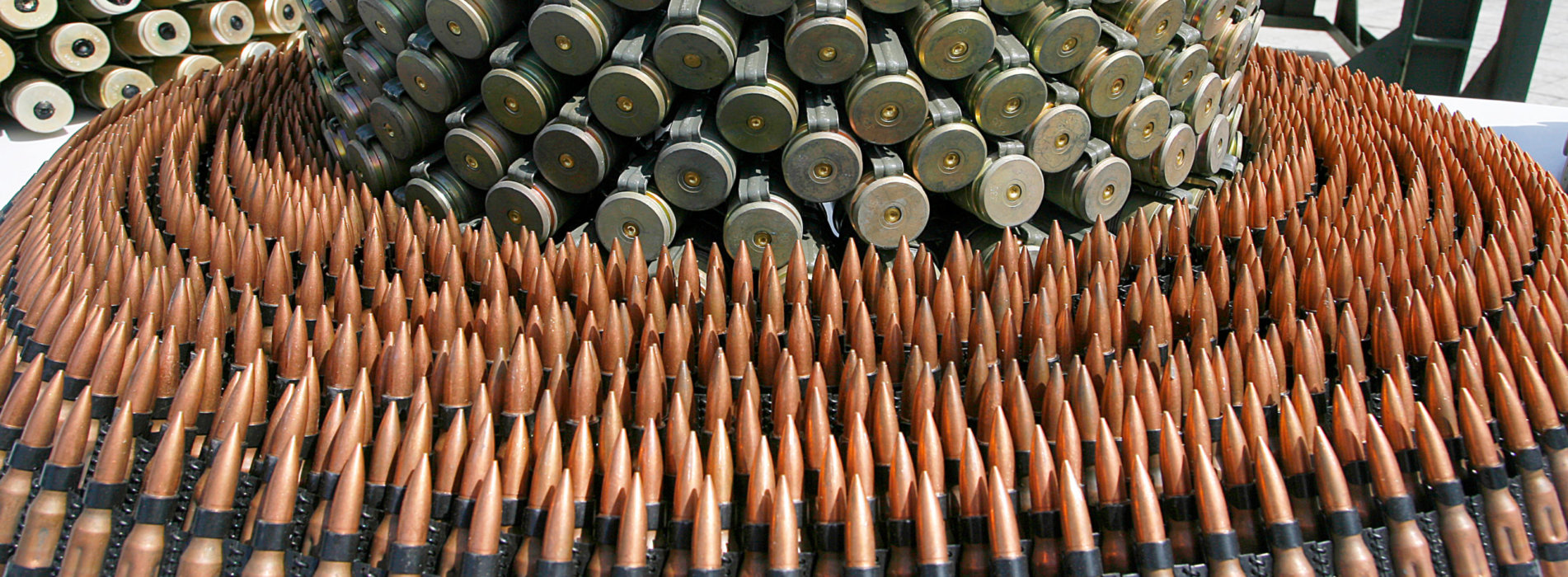
While communities and regions suffer from the scourge of war, a major beneficiary is the arms trade, a business predicated on manufacturing and exporting products and systems that cause and exacerbate human suffering.
Profitability of War
The states and companies involved in supplying arms are benefitting immensely from the escalation of conflicts worldwide, global rearmament and a heightened demand for advanced weapons technologies. In the last five years, global arms transfers have grown by nearly 10% in volume. Arms companies are likewise profiting from increased military expenditure, with arms sales and services rising by 5.9% in 2024.
In addition to profiting from wars, the arms trade is also fuelling them. The transfer of arms to conflict-prone and war-torn regions is a significant human security concern. Research has repeatedly confirmed that the availability of arms increases the likelihood of violent conflicts intensifying and has disastrous human rights and environmental impacts.
However, despite this data and countless news stories, the significant human security costs of arms transfers are routinely ignored in favour of their profitability and strategic influence. Due to the complexity and national security dimensions of this lethal business, the arms trade has remained largely resistant to transparency, scrutiny and meaningful reform. In times of war, these challenges are compounded.
As the Women’s International League for Peace and Freedom stated in the midst of World War I, “the private profits accruing from the great armament factories [are] a powerful hindrance to the abolition of war”. More than a century later, these words continue to ring true.
Costs of a New Arms Race
the significant human security costs of arms transfers are routinely ignored in favour of their profitability and strategic influence. The expansion of states’ rearmament efforts is driving competition and innovation in weapons systems, creating a new technology-driven arms race. The push to develop more precise, lethal and automated weapons technologies comes at the expense of critical resources for public services such as education, health and welfare, as well as having broader strategic and regulatory implications.
Technological advances are transforming contemporary warfare by interweaving civilian technologies with military weapons and strategies. For example, Israel has utilised cloud storage, facial recognition and data-mining systems to aid in its military attacks in Gaza. In turn, the range of actors that can influence conflict dynamics and profit from wars has expanded to include companies that build these digital technologies, software and sensors.
Moreover, the advanced capabilities of military technologies and the expanded range of actors involved are challenging established legal frameworks at a time when they are under immense strain. Important humanitarian arms controls such as the Ottawa Mine Ban Treaty and the Convention on Cluster Munitions have been sidelined, if not catastrophically undermined, as peacetime obligations. Human rights safeguards in the Arms Trade Treaty have been openly disregarded by states that have continued to export arms to recipients committing serious violations of international law.
There is a critical need for technologically literate and morally grounded approaches to regulating the arms trade that address the long-term humanitarian impacts of weapons on impacted communities and physical environments. However, political will for such reforms continues to weaken while profitability soars.
Future of the Arms Trade
the advanced capabilities of military technologies and the expanded range of actors involved are challenging established legal frameworks at a time when they are under immense strain Although other evils including Greed, Disease, and Death escaped from Pandora’s box along with War, Hope remained trapped. In the contemporary era of war, hope for a less destructive arms trade remains constrained by the pursuit of profit and power.
We are at great risk of commercial and strategic interests completely eroding human rights protections, transparency, and accountability in the arms trade. The arms industry continues to operate with impunity while maximising their profits, benefiting from rising military expenditure, states’ prioritisation of strategic interests, and declining political will to uphold regulatory safeguards.
Sustained and collective efforts are needed now more than ever. We must continue to pressure our leaders to stop using war as the pretext for immoral and destructive practices, and compel the industry to protect people over profits.
Electronic reference
Alwishewa, Hiruni . “The Arms Trade in a New Era of War.” Global Challenges, no. 20, October 2026. URL: https://globalchallenges.ch/issue/20/the-arms-trade-in-a-new-era-of-war.Anticipating the many events that will mark the Institute’s Centenary in 2027, this issue is the first instalment of a special double issue on war and peace, to be followed next spring by a second part focusing on peace and the dynamics of its necessary re-affirmation. Edited by Professor Andrew Clapham and produced by the Research Office, it was first published in Le Temps in September 2026.
TABLE | Trends in the 10 Largest Military Budgets (billions of US dollars)
| Country | 2020 | 2024 | 2026 (estimation) |
|---|---|---|---|
| USA | 778 | 968 | > 1000 |
| China | 252 | 318 | 360 |
| Russia | 62 | 150 | 200 |
| Germany | 53 | 86 | 120 |
| India | 73 | 86 | 98 |
| UK | 70 | 91 | 92 |
| Ukraine | 6 | 70 | 95 |
| Saudi Arabia | 57 | 82 | 85 |
| France | 53 | 67 | 72 |
| Japan | 49 | 57 | 68 |
In 2025, the top three military powers (the United States, China, and Russia) spent a total of USD 1,480 billion, representing more than half of global military spending. Germany was Europe’s largest military spender with USD 114 billion, significantly surpassing France and the United Kingdom.
Source: SIPRI, https://www.sipri.org. Table produced by the Geneva Graduate Institute’s Research Office.
© Geneva Academy of International Humanitarian Law and Human Rights
PODCAST: War WATCH – Ukraine: The Human Cost of Drones
Episode 6 of the War Watch series (Geneva Academy).
PODCAST | The future of European security
Research Office – Geneva Graduate Institute
PODCAST | War WATCH: the portal that tracks armed conflicts worldwide
Research Office – Geneva Graduate Institute